
How to Shape Burger Patties That Cook Evenly Every Time
Knowing how to shape burger patties is one of the simplest ways to upgrade a homemade burger. The right shape means even cooking, a juicy center, and a patty that holds together from grill to bun. At Zac’s Burger in Princeton Junction, NJ, we hand form our halal, grass-fed beef patties fresh and cook them to order, so we have learned plenty about what works. Here is how to do it at home.
This guide goes deep on forming technique. For the full picture, from choosing meat to assembling the final burger, see our guide on how to make the perfect burger at home.
Why Proper Patty Shaping Matters for Even Cooking
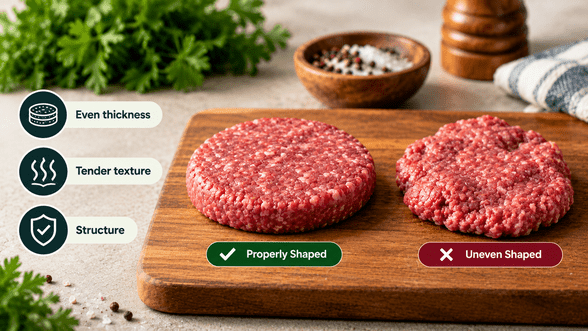
A burger patty is just ground beef, so shape does most of the work. A patty with thin edges and a thick center cooks unevenly: the outside dries out while the middle lags behind. A patty that is packed too tightly turns dense and tough. And one that is loosely formed crumbles on the grill.
Good shaping gives you three things:
- Even thickness so every bite finishes cooking at the same time.
- A tender texture because the meat is not compressed.
- Structure so the patty survives flipping.
Ideal Burger Patty Thickness and Diameter
Many people ask, how thick should burger patties be? For a classic grilled or pan-cooked burger, aim for about 3/4 inch thick. A quarter pound to a third of a pound of beef (4 to 5.3 ounces) is a good range for most home cooks.
Burger patties shrink as they cook, often by about a quarter of their width. Form each patty roughly half an inch wider than your bun, so after cooking it lands right at the edge of the bread.
Thinner patties suit a different style. If you want a crispy, lacy crust, try our smash burger recipe, where patties are pressed flat on purpose.
How to Handle the Meat Without Overworking It
Overworking is the most common mistake in hand formed burger patties. The more you squeeze and knead, the denser and rubbery the burger becomes.
- Keep the beef cold. Cold fat stays in small pieces and keeps the burger juicy. Pull it from the fridge right before shaping.
- Divide first. Weigh or eyeball equal portions so all patties match.
- Form a loose ball. Gently toss the meat from hand to hand a few times, just enough to bring it together.
- Flatten softly. Press with your palms into a disk. Stop as soon as it holds its shape.
Season the outside right before cooking, not mixed deep into the meat. Our burger seasoning blends guide has easy ideas.
The Dimple Technique: Preventing Puffed Centers
Why do you put a dimple in a burger patty? As the proteins tighten over heat, the center pushes upward and the patty puffs into a dome, sometimes called the burger ball. A dome is hard to top and cooks unevenly.
The fix is easy. After shaping, press your thumb or the back of a spoon into the center to make a shallow indent about 1/2 inch wide and a little less than 1/4 inch deep. As the patty cooks, the center rises and levels out, leaving a flat surface.
To keep burger patties from puffing up, also avoid pressing down with a spatula while cooking. That only squeezes out the juices.
Hand Shaping vs Burger Press: Pros and Cons
Should you use a burger press? It depends on your goals.
Hand shaping
- Gives a looser, more tender texture.
- Needs no special tools.
- Takes a bit of practice to keep patties uniform.
Burger press
- Makes consistent size and thickness quickly.
- Helpful when cooking for a crowd.
- Easy to over-compress, which makes patties dense.
If you use a press, apply light pressure and use parchment between patties. Many home cooks do best hand shaping, then checking size against the bun.
Creating Clean Edges That Hold Together
To shape burgers without them falling apart, pay attention to the edges. Cracked or ragged edges are where patties split on the grill.
- Rotate the patty in your palm as you flatten it, smoothing the rim with your fingertips.
- Gently pat any loose bits back in rather than pressing hard.
- Chill formed patties for 15 to 30 minutes so the fat firms up.
- Use beef with enough fat. Leaner blends crumble more easily.
- Flip only once if you can, using a wide spatula.
Fresh grass-fed beef is flavorful and holds well when handled gently, which is why we start with quality meat at Zac’s Burger.
Make-Ahead Tips: Shaping and Storing Patties
Shaping ahead saves time for cookouts and busy weeknights.
- Refrigerate: Place patties on a tray with parchment between layers, cover, and keep chilled until cooking, ideally within a day.
- Freeze: Freeze on a tray first, then transfer to a freezer bag with parchment between each patty. See our guide on how to cook frozen burgers for the best results.
- Keep the dimple: Add it before storing so it is ready to go.
Quick Shaping Checklist
- Keep the meat cold and handle it lightly.
- Form patties about 3/4 inch thick and slightly wider than the bun.
- Press a shallow dimple in the center.
- Smooth the edges and chill before cooking.
- Season the outside just before the heat.
Skip the Shaping and Let Us Do It
Want a perfectly formed burger without the work? Explore our burger menu and articles. Our handcrafted, made-to-order halal burgers are available for dine-in and online ordering at Zac’s Burger in Princeton Junction, NJ, and we also cater events. Come taste what careful shaping and fresh grass-fed beef can do.